On 29 July 2026, Minister for Climate, Energy and the Environment Darragh O’Brien announced the commencement of a new White Paper on Ireland’s energy sector (DCEE, 2026). Its aim is to map out Ireland’s path to a transformed energy system based on electricity that is clean, secure and affordable.
The announcement followed the European Commission’s Electrification Action Plan, published earlier that month (EC, 2026).
The Electrification Action Plan envisions a European Union in which 46% of energy use comes from electricity by 2040, up from 23% in 2024. Electrification is framed as a pathway to reduce Europe’s dependence on imported fossil fuels, decarbonise and deliver savings to consumers.
However, the relationship between electrification, energy independence, decarbonisation and affordability is not straightforward. The comparison below illustrates the different starting points for Ireland and the EU across these measures.
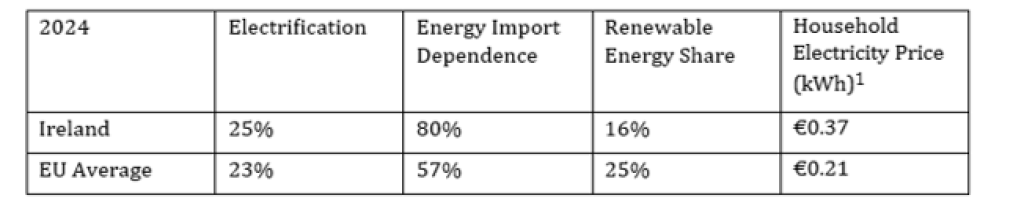
These figures provide context rather than establish a direct relationship between electrification, import dependence, renewable energy and prices. Electricity production itself can depend on imported fossil fuels. Increasing electricity use therefore needs to go hand in hand with changes to how electricity is generated, supplied and paid for.
The challenge is to electrify in a way that increases energy security and supports climate objectives at an acceptable cost to the State and consumers. These objectives can reinforce one another, but they can also create competing demands. Policymakers must navigate this energy “trilemma”, balancing priorities while building a practical path forward.
The energy trilemma
Why is it so challenging to build and maintain an energy system that is at once clean, secure and affordable? Substantive changes to decarbonisation and security require investment.
The Celtic Interconnector project, for example, will allow for the exchange of 700 MW of electricity between Ireland and France, provide a new source of electricity supply and support decarbonisation (EirGrid, 2026). The interconnector is one of the largest infrastructure projects in the State, and estimates of its likely final cost now run to more than €2 billion (Irish Times, 2026). EirGrid bears part of the project’s cost and partly funds itself through network tariffs.
Similarly, the Government approved the development of a State-led strategic gas emergency reserve following an energy security review (DCEE, 2025). Gas Networks Ireland, the system operator, will be responsible for delivering the project.
In announcing the gas reserve, Minister O’Brien emphasised its consistency with Irish climate law, although critics have warned that it could further entrench fossil fuel use. Officials also refused to rule out recovering some of the project’s costs through higher household bills (Oireachtas, 2026).
Building energy infrastructure, whether for decarbonisation or security, incurs costs. These investments can create near-term pressures on affordability. Their effect on household and business bills depends on how projects are financed and regulated, and on the savings they deliver across the system.
Increasing the share of electricity generated by wind and solar can lower generation costs when conditions are favourable. However, variable generation also requires investment to maintain security of supply, including grid reinforcement, flexibility and backup capacity.
Prioritising security, meanwhile, can involve retaining a role for fossil fuels, creating further challenges for decarbonisation.
Balancing the energy trilemma is a complex task. Electrification offers a path forward, but its benefits depend on how Ireland develops the infrastructure, generation and policies needed to support it.
Electrification: a panacea?
In his recent address to the European Parliament, Darragh O’Brien said that “Ireland shares the view of the European Commission that the only lasting way out of fossil fuel dependency is to modernise by shifting electricity generation to renewables and clean energy, and by electrifying the economy as rapidly as possible”.
This statement sums up the overarching plan in two steps:
Make electricity generation more renewable.
Increase the proportion of energy use that is based on electricity.
Step one has seen some progress. A key benchmark is the renewable energy share in electricity, known as RES-E. SEAI figures show that RES-E was 41.9% in 2024, compared with 39.1% in 2020, a relatively modest gain. New milestones, such as the successful ORESS offshore wind auction, point to further development.
Step two involves increasing the rate of electrification. Electricity accounts for around 25% of Ireland’s final energy consumption. Making that electricity cleaner addresses only part of the challenge: Ireland must also increase the use of electricity in activities that currently depend heavily on fossil fuels, notably home heating and transport.
Increasing both RES-E and electrification would help raise Ireland’s overall renewable energy share, which stands at 17.2%. This is comparable to the EU average in 2014.
Ireland therefore has considerable ground to make up. We need both cleaner electricity and a greater role for electricity across the wider economy.
A retrospective on energy White Papers
The scale of the challenge is clear, but how will the Government respond? A White Paper can be an important part of that process, setting out the Government’s position and intended policy direction.
The first electricity-focused White Paper was developed in 1978, at a moment with parallels to the present. Ireland was facing upheaval in global energy supplies caused by conflict in the Middle East, creating an urgent need for the power system to adapt.
The authors of that White Paper warned about the prospect of Ireland’s oil import dependency reaching 80% by 1990. Today, Ireland’s overall energy import dependency stands at around 80%. Although these measures differ, both illustrate the strategic concerns associated with reliance on external energy supplies.
The 1978 White Paper recommended diversifying Ireland’s electricity production through coal and nuclear generation. Moneypoint power station was subsequently commissioned and constructed in the 1980s. Running on coal, it produced 25% of Ireland’s electricity requirements at its peak.
In recent years, Moneypoint has been chiefly associated with high greenhouse gas emissions. At the time of its construction, however, it represented a significant response to concerns about energy security and dependence on oil.
Later energy White Papers, including those published in 2007 and 2015, placed increasing emphasis on competition and decarbonisation. Their influence continues to shape Irish energy policy.
A new White Paper is therefore a significant opportunity to set the direction for the next stage of Ireland’s electricity transition. Its impact will depend on whether technical and policy solutions are supported by a coherent political programme capable of delivering them.
The test for the new White Paper will be its ability to translate ambition into implementation. That means making clear choices about infrastructure, investment, regulation and the distribution of costs.
As DCEE said in its announcement, “regular and ongoing engagement with stakeholders” will be central to the process. Industry can contribute practical knowledge of delivery challenges, investment conditions and regulatory barriers, helping policymakers understand how proposed measures would work in practice.
At Hanover, we help organisations bring that perspective into policy discussions, from consultation responses and corporate communications to strategic advice and high-level bilateral engagement.
Ireland’s next chapter of energy policy is taking shape. For businesses, the task is to identify the decisions that matter to them and prepare a clear, evidence-based contribution.
