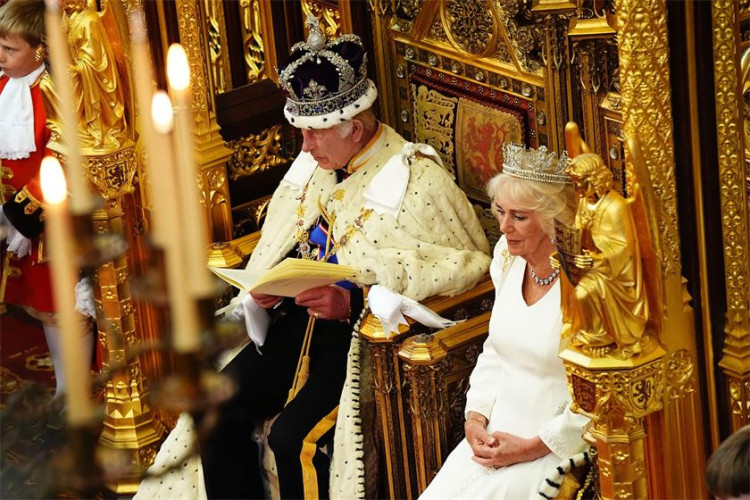
Rarely, if ever, in the centuries-old tradition of the monarch addressing Parliament, can a King’s Speech have been delivered in the shadow of such political drama.
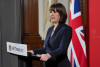
Keir Starmer began the day with a brusque 16-minute meeting at 10 Downing Street with Wes Streeting, who is widely believed to be resigning tomorrow to trigger a leadership contest against him.
The Prime Minister then trooped off to the House of Lords to hear the King read out the government’s proposed legislative programme for the next session of Parliament. But will he be the one delivering it?
‘Security’ was the guiding theme of the speech – ranging over Britain’s flatlining economy, the overseas threat, energy supplies and protection from cyber-attacks. Beset by ministerial resignations and more than 90 of his own MPs demanding he step down, it was the Prime Minister’s job security that was on most Labour minds.
Many of the proposed measures suggest that, even were Starmer to continue at No10, the government would veer slightly to the left on specific issues: nationalising British Steel and introducing more rights for both private renters and social housing tenants.
That said, the essential offer that Starmer and Rachel Reeves have made to business since their days in Opposition – a more liberal approach to regulation and supply-side reform in return for higher taxes and more stringent Labour markets, remains in place.
That much is clear from the unfortunately named but well-intentioned Regulating for Growth Bill, whose title aptly sums up the Prime Minister’s reputation for incrementalism, and moves for greater alignment with the EU on trade and security. However, the latter legislation does not cross the Prime Minister’s ‘red lines’ of remaining outside the Customs Unions and the Single Market, something that will disappoint many Labour MPs and some businesses.
In fact, the entire legislative agenda could be said to reinforce one of the main criticisms of the PM from his own backbenchers – that despite his own protests to the contrary, he just does not seem to be able to move away from ‘incremental change’.
GRINDING THROUGH THE GEARS
The policy offering was very much one of a government grinding through the gears in its second year in power, desperately searching for magical growth solutions while the continuing US-Iran war threatens a summer of higher food prices and more expensive holidays thanks to shortages of airline fuel.
The fact that so little has been achieved under Labour may make some investors wonder what benefits will issue forth in this next parliament, whoever is in charge. Gilt yields – effectively the cost of government borrowing – eased off this morning before jumping shortly after 11am – just minutes before the King began speaking.
Sharp-eyed observers noticed that this also coincided precisely with reports appearing on social media – sourced to allies of Streeting – that the Health Secretary was set to resign and spark a challenge tomorrow.
Markets inevitably react badly to political turmoil and, with questions looming over the next moves to be made by Angela Rayner, Ed Miliband and Andy Burnham, let alone Streeting, the Labour Party was giving it to the markets in spades.
In the past few days, the Prime Minister’s remaining allies attempted to frame the King’s Speech as the foundation stone of his political fightback. Now whole chunks of it are already in peril from a possible change of leadership.
As for Starmer himself, he remains at the mercy of the chain of events set in train by Labour’s disastrous performance in local elections across the country last week.
katedarkins-7.jpg)