Few expected the Irish Open weekend to become a significant political story. Yet, over a matter of days, Shane Lowry revived one of the defining moments of his career, while Donald Trump used his visit to make two striking interventions on Irish whiskey and the future of the island. The events surrounding the tournament offer an unusually vivid example of the kind of opportunity Ireland’s Sports Diplomacy Strategy is designed to capture.
By the time Shane Lowry reached the 18th green on Sunday afternoon, the Irish Open had already become something larger than a golf tournament. He had dominated the field and finished 11 shots clear, returning to the event he first won as an amateur with one of the most significant victories of his career.
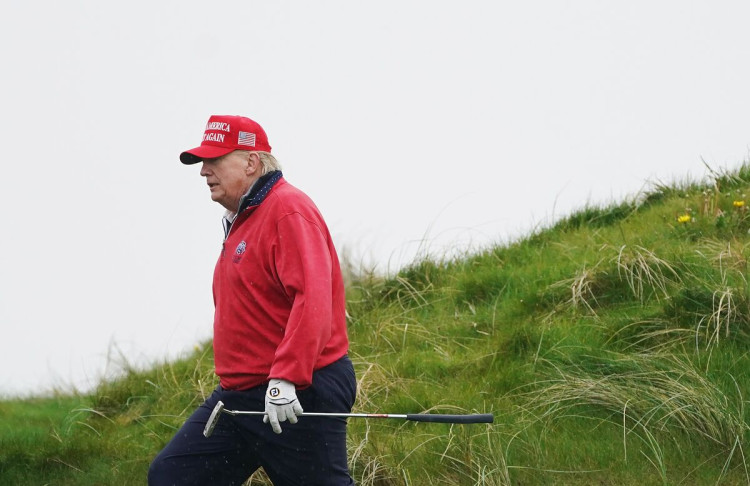
The scene around him told another story. US President Donald Trump was waiting beside the green to present the trophy, while Air Force One, presidential helicopters and a major security operation had transformed the atmosphere around the course. A sporting event in west Clare had become the setting for a much broader political visit.
That wider significance became clear as the weekend unfolded. Trump expressed support for the prospect of a united Ireland, a striking intervention from a serving US President given the historic role of the United States in supporting the peace process. He also announced that he intended to remove the 10% tariff on Irish whiskey, an issue that had been pursued by Government and industry through the wider EU-US trade relationship.
Those two interventions gave the weekend its political weight. The tournament created a setting in which sport, diplomacy and trade converged. It brought the US President to Ireland, generated high-level political engagement and created opportunities for Irish political, sporting and commercial interests to enter the conversation in an unprecedented fashion.
The whiskey issue is particularly instructive. The commercial case had already been developed and raised through political and trade channels. The Irish Open added another route. Trump said that both Taoiseach Micheál Martin and even Shane Lowry had raised the issue with him, demonstrating how the same Irish priority reached the President through different channels during the visit.
His comments on Irish unity were of a different flavour, but they underlined the same broader point. A visit centred on a sporting event had become a platform for discussion of one of the most significant political questions on the island.
Against that backdrop, the events in Clare provided an early test case for Ireland’s Sports Diplomacy Strategy and a useful lens through which to examine how Government hopes to use major sporting occasions to advance wider national interests.
Ireland published its first International Sports Diplomacy Framework in May 2025. This was followed in February 2026 by a dedicated International Sports Diplomacy Strategy running to 2030. Developed by the Department of Foreign Affairs and Trade and the Department of Culture, Communications and Sport, the strategy sets out 68 actions aimed at using sport more deliberately to support Ireland’s international relationships, reputation and economic interests.
Major sporting events bring political leaders, investors, business figures, athletes, sponsors, diaspora communities and international media into the same place. For Ireland, that concentration of attention creates opportunities that extend beyond the competition itself.
The strategy is intended to help Government and State agencies identify those opportunities in advance. One event may lend itself to political engagement, while another may create opportunities for trade, tourism, investment or diaspora outreach. The focus is on understanding who the event will attract, which relationships matter and where wider national interests can be advanced.
Ireland already has the institutions needed to make use of those moments. IDA Ireland, Enterprise Ireland, Tourism Ireland and national sporting bodies each bring different relationships and objectives. The strategy brings those strengths into the same frame around major events, with their wider political, economic and reputational value considered from the outset.
Preparation is already underway for the Ryder Cup, UEFA EURO 2028 and the T20 World Cup. Ahead of the Ryder Cup, major investment is being directed towards transport and infrastructure around Adare, a new national cricket stadium is being developed at the Sport Ireland Campus ahead of the T20 World Cup with preparations also underway for Ireland’s role in UEFA EURO 2028
Taken together, those projects show the scale of the wider ambition. The strategy is being developed alongside investment in the venues, transport and capacity needed to bring major events, and the audiences around them, to Ireland.
Each event brings a different network of political, commercial and international relationships into focus. The investment around them creates the conditions for those networks to gather in Ireland, while the strategy gives Government time to identify the relationships it wants to build around them.
The Irish Open offered an early illustration of that model in action. Over one weekend, sport created political access, international visibility and space for wider Irish interests to enter the conversation. The events ahead offer the opportunity to build around that same convergence with years of preparation behind them.
Ireland has always benefited from the international reach of its athletes, supporters and sporting organisations. The Sports Diplomacy Strategy connects that reach more clearly to foreign policy, trade, investment, tourism and diaspora engagement, making sport a more purposeful part of Ireland’s international activity.
The Ryder Cup, UEFA EURO 2028 and the T20 World Cup will each put different audiences, markets and relationships within reach. Government, State agencies and sporting bodies will have the opportunity to identify those relationships early, coordinate around them and build engagement long before the first ball is struck.
For businesses, the same dynamic applies. Major sporting events create concentrations of political, commercial and media attention that extend well beyond the competition itself. Organisations that understand the stakeholder landscape early, identify the relationships that matter and position themselves credibly around those moments will be best placed to benefit from them.
At Hanover Communications Dublin, we have worked with businesses and organisations to understand that wider environment and translate it into a clear engagement strategy for 10 years. With several major international sporting events already on Ireland’s horizon, the opportunity to plan for those moments starts well before the opening ceremony.